Quick answer: The Lahiri (Chitrapaksha) ayanamsa was 24°12′23″ on 1 January 2025 and 24°13′13″ on 1 January 2026 (24°13′49″ on 15 September 2026). It grows by about 50.29″ every year, which is one degree roughly every 71.6 years. Values on this page come from the Swiss Ephemeris.
Correction (15 September 2026): An earlier version of this article gave the 2025 ayanamsa as 39.35°. That was wrong. The calculation added Earth’s axial tilt (23.44°) to the precession, but axial tilt has nothing to do with ayanamsa. The correct Lahiri value for 2025 is about 24.21°. The article below has been rewritten with verified values.
What is ayanamsa?
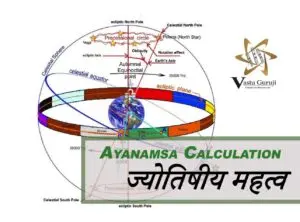
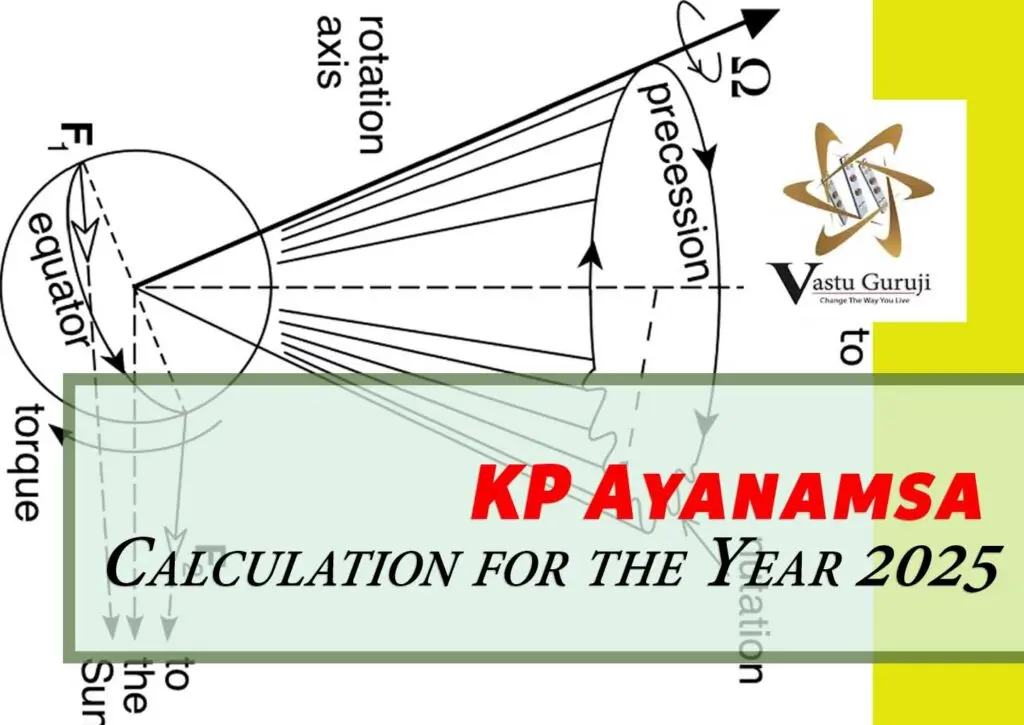
Ayanamsa (अयनांश) is the angle between the tropical zodiac (Sayana, used in Western astrology, which starts from the spring equinox) and the sidereal zodiac (Nirayana, used in Vedic astrology, which is fixed to the stars). The gap exists because of the precession of the equinoxes: Earth’s axis wobbles slowly, so the equinox point moves backwards against the stars by about 50 arc-seconds a year. For a full explanation of the concept, see Ayanamsa meaning and types.
In practice, every Vedic chart uses one simple rule:
Sidereal (Nirayana) longitude = Tropical (Sayana) longitude − Ayanamsa
How to calculate the Lahiri ayanamsa for any year
Exact values come from an ephemeris (a table or program of planetary positions), which applies the full precession model. For everyday use, a simple linear formula is accurate to about one arc-second between 1900 and 2050:
Lahiri ayanamsa (1 January of year Y) ≈ 23°51′25.5″ + 50.29″ × (Y − 2000)
- 23°51′25.5″ is the Lahiri ayanamsa on 1 January 2000.
- 50.29″ (arc-seconds) is the average yearly increase caused by precession.
Worked example: ayanamsa for 2025
- Years since 2000: 2025 − 2000 = 25
- Precession added: 50.29″ × 25 = 1,257.25″ = 20′57.25″
- Add it to the 2000 value: 23°51′25.5″ + 20′57.25″ = 24°12′22.75″
- Result: Lahiri ayanamsa on 1 January 2025 ≈ 24°12′23″ (24.2063°). This matches the Swiss Ephemeris value.
Worked example: converting a planet to sidereal
On 14 January 2025 at 06:30 UT, the Sun’s tropical longitude was 294°20′15″ (24°20′ Capricorn in Western astrology). Its sidereal longitude with the Lahiri ayanamsa was 270°07′49″, which is 0°07′49″ in Makara. So the Sun had just entered Makara, which is Makar Sankranti. The 24° gap between the two numbers is the ayanamsa.
Lahiri ayanamsa table (1900–2030)
Values are for 1 January, 00:00 UT, from the Swiss Ephemeris (Lahiri / Chitrapaksha).
| Year | Lahiri ayanamsa | Decimal degrees |
|---|---|---|
| 1900 | 22°27′38″ | 22.4605° |
| 1950 | 23°09′31″ | 23.1587° |
| 2000 | 23°51′26″ | 23.8571° |
| 2010 | 23°59′48″ | 23.9968° |
| 2020 | 24°08′11″ | 24.1365° |
| 2021 | 24°09′02″ | 24.1505° |
| 2022 | 24°09′52″ | 24.1644° |
| 2023 | 24°10′42″ | 24.1784° |
| 2024 | 24°11′32″ | 24.1923° |
| 2025 | 24°12′23″ | 24.2063° |
| 2026 | 24°13′13″ | 24.2203° |
| 2027 | 24°14′03″ | 24.2343° |
| 2028 | 24°14′54″ | 24.2482° |
| 2029 | 24°15′44″ | 24.2622° |
| 2030 | 24°16′34″ | 24.2762° |
Lahiri vs KP vs Raman vs True Chitra ayanamsa
Different traditions fix the starting point of the sidereal zodiac to slightly different stars or dates, so their ayanamsas differ. Values below are for 1 January (Swiss Ephemeris).
| Ayanamsa | 2025 | 2026 | Difference from Lahiri | Used by |
|---|---|---|---|---|
| Lahiri (Chitrapaksha) | 24°12′23″ | 24°13′13″ | — | Indian Government panchang (Rashtriya Panchang), most Indian astrologers |
| True Chitra | 24°11′20″ | 24°12′11″ | about 1′ smaller | Astrologers who fix the star Chitra (Spica) at exactly 180° |
| KP (Krishnamurti) | 24°06′34″ | 24°07′24″ | 5′49″ smaller | Krishnamurti Paddhati (KP) astrology |
| Raman | 22°45′36″ | 22°46′26″ | 1°26′47″ smaller | Followers of B.V. Raman |
| Fagan-Bradley | 25°05′22″ | 25°06′13″ | 53′ larger | Western sidereal astrology |
The Lahiri ayanamsa was recommended by the Indian Calendar Reform Committee (1955) and is the standard used in the Indian national ephemeris. That is why most Indian panchangs and kundli software use it by default. If you want to follow one system consistently, see Lahiri ayanamsa explained.
Why ayanamsa matters: it shifts your dasha dates
Your Vimshottari dasha does not depend on your birth year. It depends on the nakshatra of the Moon at birth and on how far the Moon had already travelled through that nakshatra. That position is a sidereal longitude, so it changes with the ayanamsa you choose.
- Each nakshatra spans 13°20′. If the Moon is in a Venus-ruled nakshatra, which carries a 20-year dasha, each 1° of the Moon’s position equals 20 ÷ 13.33 = 1.5 years of dasha.
- Lahiri and Raman differ by 1°26′47″ (1.45°), so the same birth time can move Venus dasha dates by about 2 years 2 months.
- Lahiri and KP differ by only 5′49″, which moves dasha dates by roughly 53 days.
Vimshottari dasha periods
| Dasha lord | Years | Starts at birth when the Moon is in |
|---|---|---|
| Ketu (केतु) | 7 | Ashwini, Magha, Mula |
| Venus (शुक्र) | 20 | Bharani, Purva Phalguni, Purva Ashadha |
| Sun (सूर्य) | 6 | Krittika, Uttara Phalguni, Uttara Ashadha |
| Moon (चंद्र) | 10 | Rohini, Hasta, Shravana |
| Mars (मंगल) | 7 | Mrigashira, Chitra, Dhanishta |
| Rahu (राहु) | 18 | Ardra, Swati, Shatabhisha |
| Jupiter (गुरु) | 16 | Punarvasu, Vishakha, Purva Bhadrapada |
| Saturn (शनि) | 19 | Pushya, Anuradha, Uttara Bhadrapada |
| Mercury (बुध) | 17 | Ashlesha, Jyeshtha, Revati |
The full cycle is 120 years and runs in the order shown. The dasha running at birth is only partly left: its balance equals the part of the nakshatra the Moon had not yet crossed. For example, if the Moon is exactly halfway through Bharani, half of the 20-year Venus dasha (10 years) remains at birth. The sequence then continues with Sun, Moon, Mars and so on. Each mahadasha is divided into antardashas in the same proportions. For the lords of all 27 nakshatras, see 27 नक्षत्र और उनके स्वामी.
अयनांश 2025 और 2026 (हिंदी में)
लाहिड़ी (चित्रपक्ष) अयनांश 1 जनवरी 2025 को 24°12′23″ और 1 जनवरी 2026 को 24°13′13″ है। यह हर साल लगभग 50.29 विकला (arc-second) बढ़ता है। कुंडली में ग्रहों का निरयन भोगांश निकालने का नियम है: निरयन भोगांश = सायन भोगांश − अयनांश। KP अयनांश लाहिड़ी से लगभग 5′49″ कम और रमन अयनांश लगभग 1°27′ कम होता है। इसी अंतर से दशा की तारीखें बदल जाती हैं। इस लेख के पुराने संस्करण में 39.35° लिखा था, जो गलत था: उसमें पृथ्वी का अक्षीय झुकाव (23.44°) जोड़ दिया गया था, जिसका अयनांश से कोई संबंध नहीं है।
Frequently asked questions
What is the Lahiri ayanamsa in 2025?
24°12′23″ (24.2063°) on 1 January 2025. It rises to 24°13′13″ by 1 January 2026.
How much does ayanamsa change every year?
About 50.29 arc-seconds a year, or one full degree in roughly 71.6 years.
Is Earth’s axial tilt part of the ayanamsa?
No. Axial tilt (obliquity, about 23.44°) is the angle between Earth’s equator and its orbit. Ayanamsa is the distance the equinox point has moved along the zodiac because of precession. The two numbers happen to be similar in size, but you must never add or substitute one for the other.
Which ayanamsa should I use?
For traditional Vedic (Parashari) astrology and Indian panchang dates, use Lahiri. For KP astrology, use the KP ayanamsa. Whichever you choose, use the same one for every chart you compare.
Source of values: Swiss Ephemeris 2.10 (astro.com/swisseph), 1 January 00:00 UT.