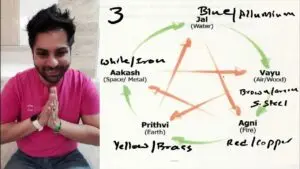
Short answer
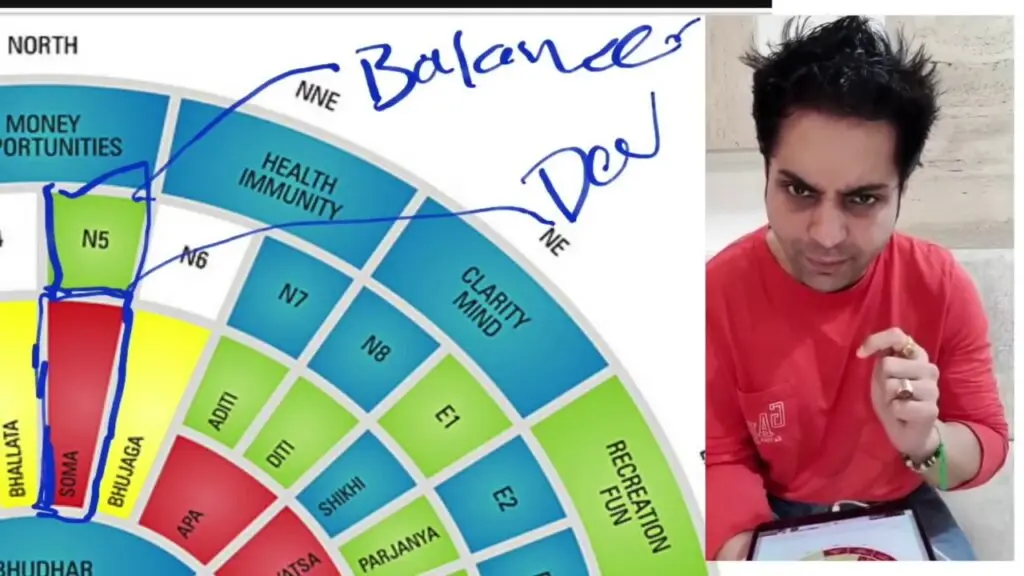
On the Vastu Chakra (Shakti Chakra), the ring just inside the outermost ring gives every devta field a balancer colour. Guruji says these colours follow one rule of the five elements: water calms red (fire), and that water is handled by green (wood) or yellow (earth). So wherever red is given, its balancer is green or yellow.
▶ Watch the full video · 10 min · Vastu Guruji (in Hindi)
Today’s topic: the balancer colours of the Vastu Chakra
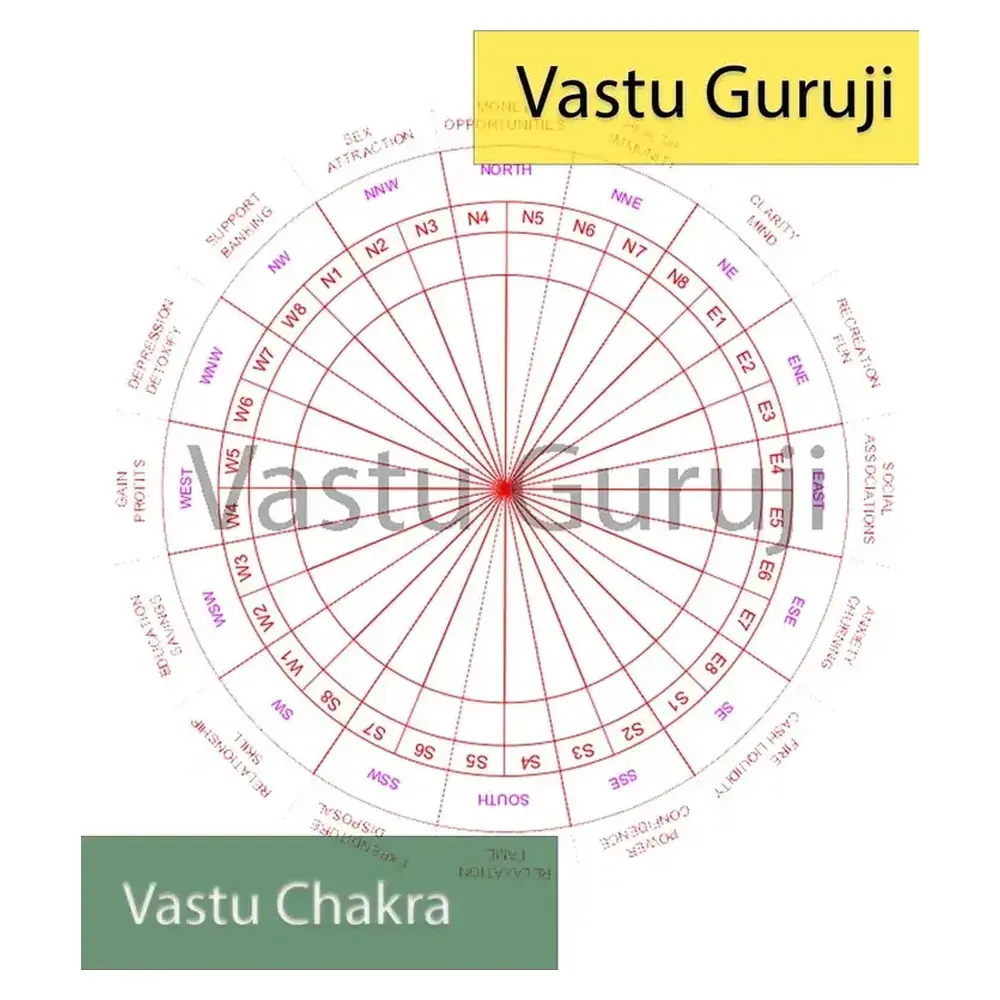
On the Shakti Chakra (Vastu Chakra), the ring just inside the outermost ring gives each devta field a number such as N5, N6 or N7 and a colour. These are called the balancer colours. In this lesson Guruji explains where these colours come from and by which rule they are used.
If you do not have a chakra yet, download the free Vastu Chakra PDF first and keep it in front of you, so you can follow every point on the chakra itself.
Guruji says this was kept like a secret for a long time. People were told “use this balancer colour”, but not why. That question was always in his mind, and it is the first thing he set out to solve.
Five elements first, then the 45 powers
Guruji is clear: you cannot skip the five element theory and still work with the 45 powers. Only when you hold the five elements firmly can you truly work with the 45 powers. So this lesson stands on the five elements from the previous lesson.
- Balancer colours are given on the ring just inside the outermost ring of the chakra.
- Every colour stands for an element; there is no random reason behind it.
- Without the five elements you cannot work with the 45 devtas.
People’s guesses: “Som is red, so put green?”
Guruji shares the questions he used to ask. If Som’s colour is red and I put green there, does Som’s energy go up? Then at N6 sits Bhujang, whose colour is yellow; by the same thinking, what should his balancer be? The answers he got did not agree with each other.
Some people even said a devta was given green because of “enmity”, or that red fire was put on another one. Guruji jokes: as if Brahma gets up, goes to Bhudhar and says “he is not our friend, press him down”, and then goes to Som and says “he is our friend”. That cannot be. There is only one principle.
There must be only one logic
Guruji says the right way to teach is one logic, not a thousand. Saying “I wore orange today, so my South is spoiled” and then stopping there is wrong. If one devta has to be increased and another decreased, one single rule must be behind it, and it must work the same way across the whole chakra.
Energy moves from devta to devta
On the chakra, energy does not stay with one devta. It moves from the inner core outwards, from one devta to the next, for example from Aryama to Aapvatsa and from Aapvatsa to Parjanya. So a devta on the outer side is being pushed by several devtas together. When this much energy reaches one place, the right balancer colour is needed to handle it.
The search for the answer
Guruji tells how he looked for the answer in what is said about the 32 devtas, with the acharyas and in the texts, but found no clear reason. Then he thought it through himself. He trusted his own teacher: if this chart was made, there cannot be anything illogical behind it. The work of the rishis and munis always has logic.
His words: in this subject, and in life too, you must come to one principle. The principle he found does not depend on friendship or enmity with any devta. It works only on the elements.
The rule: water calms red, green or yellow holds the water
For any energy field that is shown in red, first think how red (fire) can be calmed. Fix this in your mind first; then you will start seeing these colours on the chakra by yourself. To calm fire you always need water. Water is poured, the fire goes out, and the water collects there.
Now only two things can handle that collected water: the next element, green (wood), or yellow (earth), which has the capacity to hold water.
| Step | What happens | Element |
|---|---|---|
| 1 | The devta field’s colour is red | Fire |
| 2 | Water comes to calm the fire and collects there | Water |
| 3 | The next element soaks up the water | Green = wood |
| 4 | Or the water is held in place | Yellow = earth |
| Result | The balancer of red is green or yellow | — |
Guruji says: look across the whole map. Wherever red is given, its balancer is either green or yellow. It is a small point, but a straight one.
Key points of this lesson
- Balancer colours come from the rule of the elements, not from guesswork.
- Stories of friendship or enmity between devtas do not explain these colours.
- One logic must work across the whole chakra.
- Water calms red (fire); green (wood) or yellow (earth) handles that water.
- Fix the rule in your mind first, then read the colours on the chakra.
Frequently asked questions
What are balancer colours in the Vastu Chakra?
On the Shakti Chakra, the ring just inside the outermost ring gives each devta field a number such as N5, N6 or N7 and a colour. That colour is the balancer, meant to balance the element of that field.
Why is red balanced with green or yellow in the Vastu Chakra?
Red is fire, and water calms fire. The water that collects after the fire goes out is either soaked up by the next element, green (wood), or held by yellow (earth).
What should I learn before using the Vastu Chakra?
The five element theory. Guruji says only when you hold the five elements firmly can you truly work with the 45 powers.
Are Vastu colours chosen by friendship or enmity between devtas?
No. Guruji says one logic must work across the whole chakra, and that logic is of the elements, not of friendship or enmity with any devta.
How does energy flow in the Shakti Chakra?
Energy moves from the inner core outwards, from one devta to the next, for example from Aryama to Aapvatsa and on to Parjanya. So a devta on the outer side receives the energy of several devtas together.
Products used in this lesson
 Vastu Chakra 6 inch — Grid, 16 Zones & 45 Devta Editions Price range: ₹790 through ₹990View →
 Vastu Chakra (Autocad File DWG) Original price was: ₹1,999.₹790Current price is: ₹790.View →
All payments online — UPI / PhonePe / GPay / card.
📖 Read more: 45 वास्तु देवता — नाम, दिशाएँ और वास्तु पुरुष मंडल — detailed guide by Vastu Guruji Rana Sikander (vastuguruji.in).