Short answer
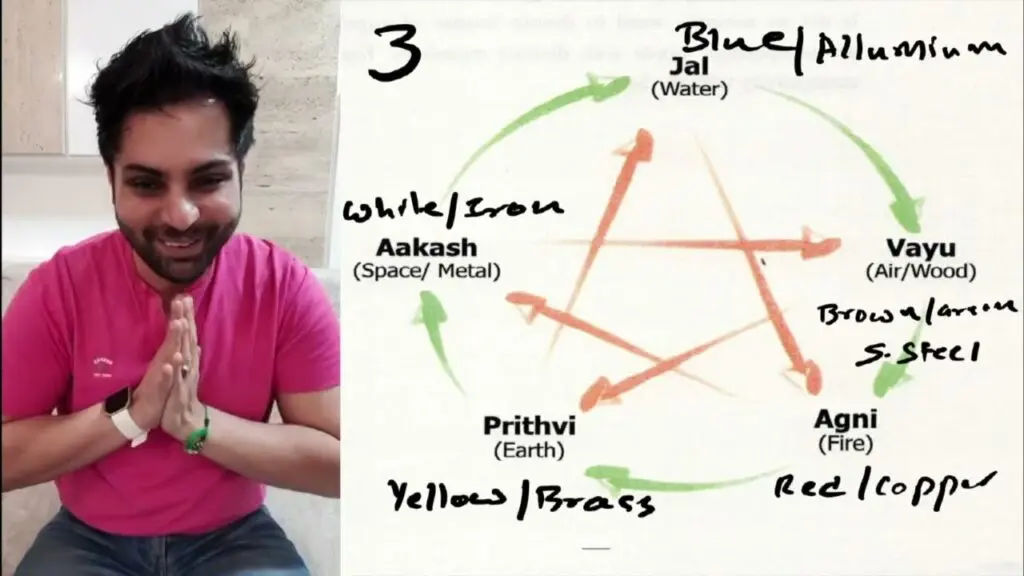
Vastu works with five elements: fire, water, earth, space (metal) and wood (air). Guruji says remembering the cycles of creation, destruction and control is not enough; what matters is which element you place on top of a zone's element. Wood on fire increases it, water on fire puts it out at once, and metal or earth on fire slowly reduces it.
▶ Watch the full video · 22 min · Vastu Guruji (in Hindi)
What are the five elements?
According to Guruji, the whole world is made of five elements. Nature runs this cycle every day: water meets earth, the fire inside the earth comes out as a volcano and cools down to become earth again. Water from ponds and rivers heats up, rises to the sky as vapour, and the same sky returns it as rain.
His own teacher told him: “Whoever understands this has understood the whole world.” Guruji says this is not a small statement. The same understanding later helps you connect the 32 devtas of the Vastu Chakra.
- The five elements: fire, water, earth, space and wood (air).
- In this method the space element is linked with metal.
- Nature’s cycle: water → earth → fire → sky → rain → water.
Why the three cycles are not enough
Most teachers explain the cycle of creation, the cycle of destruction and the cycle of control. Guruji says some links are missing in these cycles. So he takes one element at a time and asks: if I put another element on top of this one, what really happens? He calls this an “equation”, and it is the heart of this lesson.
Other elements placed on fire
Earth on fire: the fire starts to die down; its flame and heat reduce.
Metal on fire: the fire first tries to melt the metal, and the metal starts losing its form. But where does the melted metal go? It settles on the fire and in the end finishes the fire itself. Guruji’s example: put a thick piece of metal on a burning burner. Ice would melt and evaporate, but metal does not evaporate; it stays right there.
Water on fire: the fire goes out at once. This is the cycle of destruction, where one element in between is skipped.
Wood on fire: wood increases the fire and makes it burn longer. The rule: when the element that comes before reaches the next one, it supports it.
Fire on fire: the fire doubles.
How it shows up at home: an iron table on a red zone
In the Shakti Chakra, suppose a devta’s colour is red, so that zone holds the fire element. Now an iron table is placed there by mistake. Iron counts as the space (metal) element. The fire gets busy melting that metal, and the problem starts right there, because in the end the fire of that zone keeps going down. Guruji says these ideas connect with day-to-day life, so you will start seeing them in your own home.
Other elements placed on water
Earth on water: pour sand into water and the sand soaks it up; the water loses its quality. But the same water kept in a glass or a bowl (the earth element) keeps its quality and stays safe. If it rains while a volcano is erupting, the water calms the burning earth.
The blue safe example: Guruji says that money kept in a blue safe stays there. Either the savings keep growing, or no situation comes up that forces you to take that money out. Water (blue) reaching an earth-element devta makes it turn into earth again. When a safe is placed, this property works on one particular devta zone.
Metal on water: water is already present and an iron object is placed on it; it turns into something like a flood.
Water on water: it doubles. Wood on water: wood soaks up the water. This is the cycle of control.
Fire under water: steam and new opportunities
Light a fire under water and the water turns to steam. Steam catches new opportunities and travels far. While the water was solid (ice) it stayed with us; flowing water can reach anywhere. Guruji asks: if I want the energy of a North devta to turn into steam and travel far, why should I not put fire there? In other words, no rule is applied blindly; it is applied by looking at the result you want.
Other elements placed on space
| Placed on space (metal) | What happens (in Guruji’s words) |
|---|---|
| Earth | Space pulls the earth’s water towards itself; its water quality rises a little. |
| Space | It doubles. |
| Water | Space comes under control. |
| Wood | Space starts cutting the wood. |
| Fire | Fire “boils” the space, melts it and brings its quality out at once. |
That is why Guruji talks about a red bulb fitted wrongly in the West: when you want the result of a zone quickly, fire is brought onto space, the space melts and gives its quality. A red bulb fitted without understanding can also work the wrong way.
At a glance: other elements on fire and water
| Element below | Placed on top | Result |
|---|---|---|
| Fire | Earth | Fire reduces |
| Fire | Metal | Fire melts it, then the fire ends |
| Fire | Water | Goes out at once |
| Fire | Wood | Fire grows |
| Fire | Fire | Doubles |
| Water | Earth | Water is soaked up (safe if in a vessel) |
| Water | Metal | Flood-like |
| Water | Wood | Wood soaks the water |
| Water | Fire below | Steam — travels far |
Key points of this lesson
- Before placing anything in a zone, check both the zone’s element and the element of the object.
- The element that comes before supports the next one (wood → fire).
- When the element in between is skipped, destruction happens (water → fire).
- Colour is an element too: red = fire, blue = water.
- For quick results fire is brought onto an element, but only with thought.
Frequently asked questions
What are the 5 elements of Vastu Shastra?
Fire, water, earth, space and wood (air). In Vastu Guruji's method the space element is linked with metal.
What happens if iron is kept in a fire zone?
The fire gets busy melting the metal and in the end the fire of that zone goes down. That is why a heavy metal object such as an iron table on a red-coloured devta zone creates problems.
What is the cycle of creation and destruction of elements?
In the cycle of creation the element that comes before supports the next, like wood feeding fire. In the cycle of destruction the element in between is skipped, like water putting out fire directly.
Why does money stay in a blue safe?
According to Guruji, blue is the water element. On an earth-element devta zone this water turns into earth again, so the money stays: savings grow, or no need comes up to take it out.
Are colours also elements in Vastu?
Yes. In this lesson red is taken as fire and blue as water. So changing the colour of a zone is like placing a new element on that zone.
Products used in this lesson
 Devta Chakra with Elements (Autocad File DWG) Original price was: ₹1,999.₹1,290Current price is: ₹1,290.View →
 Vastu Chakra 6 inch — Grid, 16 Zones & 45 Devta Editions Price range: ₹790 through ₹990View →
All payments online — UPI / PhonePe / GPay / card.
📖 Read more: घर के लिए ज़रूरी वास्तु टिप्स — detailed guide by Vastu Guruji Rana Sikander (vastuguruji.in).