Short answer
A devmani is Vastu Guruji's devta remedy: metal dots on an iron frame that wake the energy of one devta, sold as a set of three pieces. It is fitted in three holes drilled in a triangle on the floor, facing its own direction, with the four dots down and the door balancer dots up. Where you cannot open a door, a virtual entry is one metal rod (on E3 he uses SS) pushed through the wall, close to the floor.
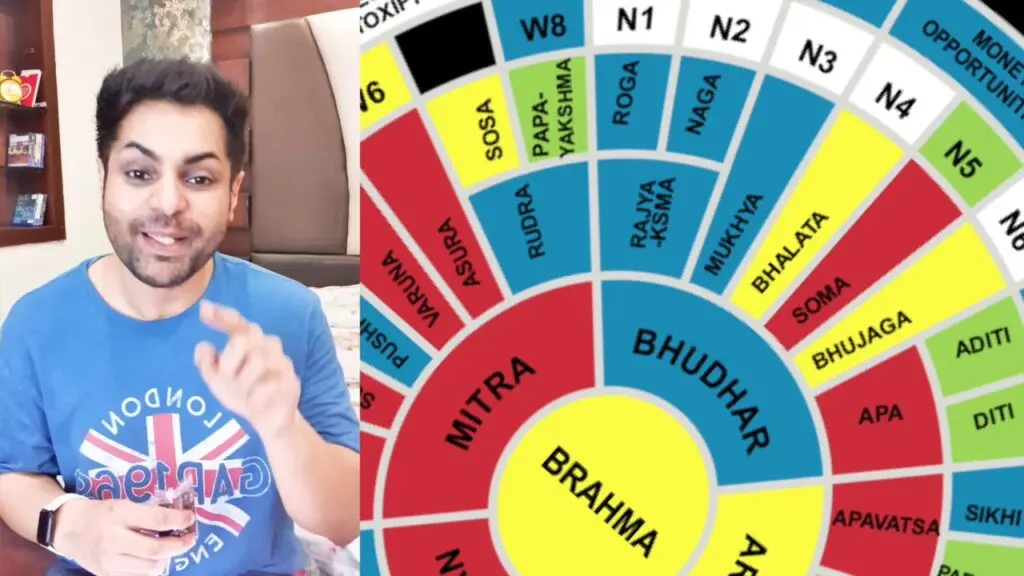
▶ Watch the full video · 18 min · Vastu Guruji (in Hindi)
What is a devmani?
In this last lesson Guruji shows two things: how a devta remedy is made and installed, and how a virtual entry is opened. Around us sit the 45 powers (devtas) of Vastu. To wake up or bring out the energy of one devta, he made sets of energy bits and named them devmani.
A devmani comes as a set of three pieces. Each piece is like a small strip: an iron frame on which metal pieces, cut in different sizes, are fixed.
What a devta is, and why one goes missing
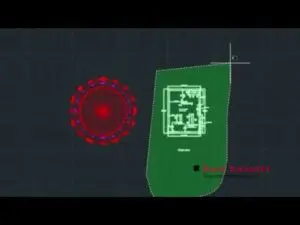
Devtas are the energies through which we run our day-to-day working pattern. Sometimes a devta is simply not present in the house. If a house is L-shaped, some devtas are cut. A house may be V-shaped, or its centre may be missing. For example, you build a fine house on the ground floor, but on the first floor you leave the middle portion open; then Brahma, who sits in the middle, may be cut. There are different procedures to restore such a devta, and the devmani made of metal pieces is one of them. To see which devta field falls where on your plan, use the free Vastu Chakra PDF.
How a devmani is made: the Pushpdant (W4) example
Every devmani follows one equation, read from a chart like the Shakti Chakra. Guruji holds the devmani of W4, Pushpdant:
- Four dots first: these belong to Vivaswan. Fire and red are used on Vivaswan, so these four dots are copper.
- Two big dots in the centre: aluminium, because the colour given to Pushpdant is blue.
- Two last dots, the door balancer: SS (stainless steel), which is the first to reduce aluminium, and brass, which holds aluminium.
All of these sit on an iron frame. Guruji says they made it strong, with a good amount of metal.
Two more examples: Bhallat (N4) and Sugreev (W3)
Bhallat is fitted on N4. Its first four dots are aluminium, taken from the Bhudhar energy of the centre part on his chart. Bhallat’s own colour is yellow, so two brass dots come next. Then the door balancer for brass: SS destroys brass, and iron (RN) controls it. Since iron is already there as the frame, aluminium is used in its place. So one SS dot and one aluminium dot go last.
For Sugreev in the West (W3), the four small dots are again Vivaswan’s copper pieces, and Sugreev’s two dots are copper too, a little bigger in size. Its door balancer is brass, which stops copper, and aluminium.
| Devmani | Four dots | Two dots | Door balancer |
|---|---|---|---|
| Pushpdant (W4) | Copper (Vivaswan) | Aluminium (blue) | SS + brass |
| Bhallat (N4) | Aluminium | Brass (yellow) | SS + aluminium |
| Sugreev (W3) | Copper (Vivaswan), small | Copper, bigger | Brass + aluminium |
You can make a devmani at home: take an iron strip and mount metal pieces like these on it. Or you can buy a ready-made set.
How to install a devmani on the floor
You need the devmani set of three pieces, a drill machine with a bit, a marker pen, a hammer to tap the pieces in, and white cement. Guruji installs a Sugreev devmani in the West:
- Place the devmani at its spot and mark around it with white tape, so the holes are only as big as needed for it to go in fully.
- With the marker, make three dots: two towards the wall and the third in front, forming a triangle. Guruji explains that a new energy is set up at the two dots and thrown forward.
- Drill a hole at each point of the triangle. Do not drill deeper than the white mark, or the hole may come out in the ceiling of the floor below. Stay on your own floor.
- Fit the three pieces from the packet. Each piece faces the direction you are installing it in: in the West, it faces West.
- The four dots stay at the bottom, the two big dots in the middle and the two door balancer dots at the top. Keep it straight and tap it in with the hammer.
- When all three are in, clean the dust and apply a coat of white cement. The marker line on the tile goes away too.
What a virtual entry is, and which rod to use
A virtual entry is made where you cannot open a door. Through it, an entry is created so that the devta energy connects with your home. Guruji says it is very easy.
Walls are usually 9 inch thick, with about 1 inch of tiles on each side, so 10 to 12 inch in all. Take a rod a little longer than the wall. For his demo he bought a 14 mm, 16 inch rod from the market. The rods in the Vastu Guruji store are usually 12 mm and 12 inch, on purpose, so they fit almost any wall. He opens this entry on E3 and uses an SS rod, because of its self colour, silver.
How to open a virtual entry
You need a drill machine with a bit, the rod, a hammer and tape. Stick a white paper mark on the drill bit so you know how far you have gone.
- Drill at the marked spot. As the bit nears the white mark, a light push takes it through to the other side.
- Take the rod in your hand and tap it in with the hammer.
- On the inside, keep it close to the floor; do not raise it above floor level.
- Let it stick out a little on the outside and a little on the inside.
- Do not fall into confusions such as taking it down into the ground or grounding it from top to bottom. One rod through the wall is all it takes.
A real case: a child who studies but scores low
Guruji explains why he used these two in the video, a W3 devmani and an E3 virtual entry with an SS rod. A family told him their child wants to study and does study, but the results are not good. When he counselled the child, he found the child was feeling a little depressed. Because the child wants to study, he used the SS rod for the child’s self colour, and with the devmani he worked on the devta of the memory bank.
- A devmani wakes the energy of one devta; it is read from the devta’s colour and its door balancer.
- Install it facing its own direction: four dots down, door balancer dots up.
- A virtual entry is one rod through the wall, close to the floor; on E3 he uses SS.
- When a child seems low or depressed, talk to a doctor or counsellor too; the remedy does not replace that.
Frequently asked questions
What is a devmani in Vastu?
A devmani is Vastu Guruji's devta remedy: metal dots fixed on an iron frame that wake the energy of one devta. It comes as a set of three pieces.
How do you install a Vastu devta remedy at home?
Mark the spot with tape, drill three holes in a triangle, and fit the three pieces facing the direction you are installing in: four dots down, door balancer dots up. Tap them in with a hammer and finish with white cement.
How do you open a virtual entry in Vastu?
Where you cannot open a door, drill through the wall and tap one metal rod (Guruji uses SS on E3) right through it. On the inside the rod stays close to the floor, and it sticks out a little on both sides.
Which rod is used for a virtual entry?
On E3 Guruji uses an SS rod because its self colour is silver. The store rods are usually 12 mm and 12 inch, which fit most 10 to 12 inch walls.
Does a virtual entry rod need grounding?
No. Guruji says not to fall into confusions such as taking it into the ground or grounding it from top to bottom; one rod through the wall is enough.
What happens if a devta is cut in a house?
An L-shaped or V-shaped house, or an open middle portion, can cut some devtas, such as Brahma in the centre. There are several ways to restore them, and a devmani is one of them.
Products used in this lesson
 Advance Devta Field Booster — Pushpdant (W4) Original price was: ₹4,000.₹2,490Current price is: ₹2,490.View →
 Advance Devta Field Booster — Bhallat (N4) Original price was: ₹4,000.₹2,490Current price is: ₹2,490.View →
 Advance Devta Field Booster — Sugreev (W3) Original price was: ₹4,000.₹2,490Current price is: ₹2,490.View →
 Stainless Steel Rod 12 inch (12 mm Diameter) Original price was: ₹1,290.₹945Current price is: ₹945.View →
All payments online — UPI / PhonePe / GPay / card.
📖 Read more: 45 वास्तु देवता — नाम, दिशाएँ और वास्तु पुरुष मंडल — detailed guide by Vastu Guruji Rana Sikander (vastuguruji.in).